Automotive-Related Sector Employment in Windsor, Ontario
The automotive sector has historically been the foundation of Windsor’s economy, shaping its employment structure, industrial identity, and economic stability. With major players such as Ford and Stellantis, each unit of employment could create up to six additional units of indirect employment. Source: Facts - CVMA
However, recent trends and expert concerns have been raised about Windsor’s uncertain automotive future—suggesting that this dominance may be changing: See CTV article - Windsor shifting focus in the future?
Perhaps Windsor’s economic diversification has been long overdue, as this may lead to a more stable economy.
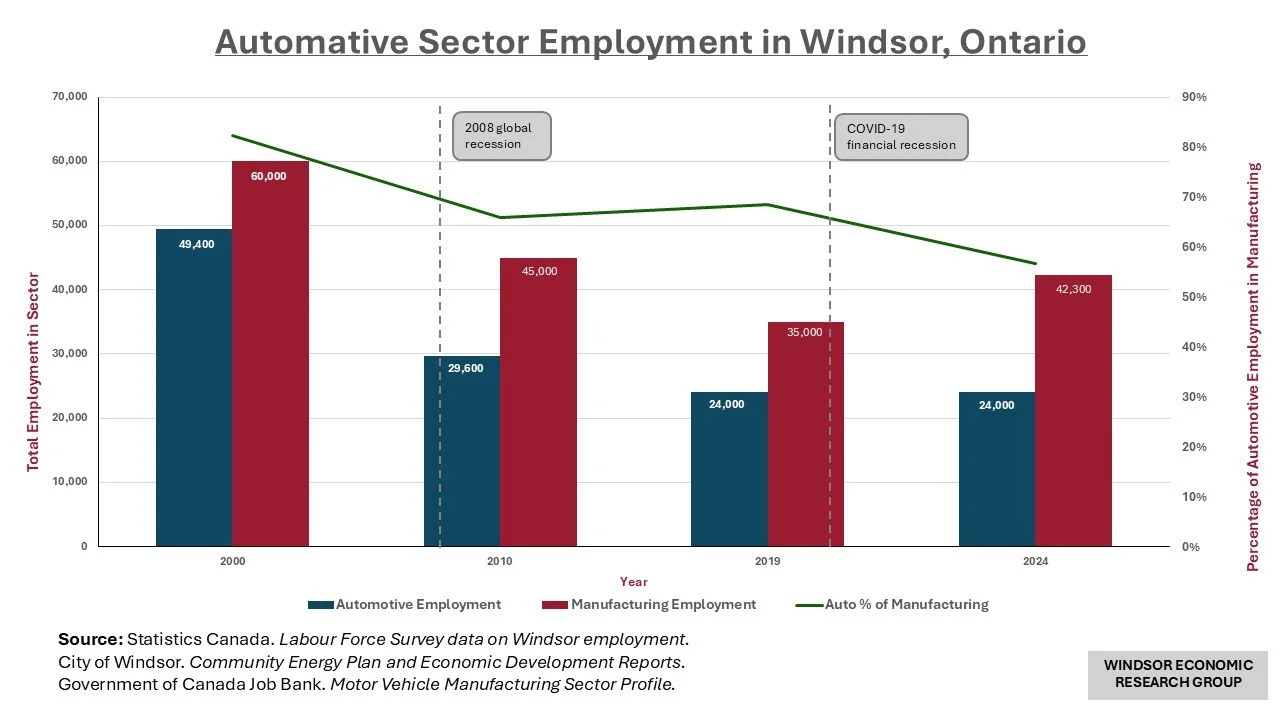
The graph above illustrates a clear long-term trend: automotive employment in Windsor declined sharply from approximately 49,400 jobs in 2000 to around 29,600 in 2010. This represents a loss of nearly 40% of the workforce in just a decade (while the population has grown), largely due to automation, globalization, and the restructuring of North American manufacturing. Recent trade shocks have only exacerbated these concerns.
Since 2010, automotive employment has stabilized at roughly 24,000 jobs, but it has not returned to previous levels.
In contrast, total manufacturing employment, while also declining during the same period, has shown signs of recovery in recent years.
In 2024, we estimate manufacturing employment rose to over 42,000 jobs, indicating that Windsor’s industrial base is diversifying beyond traditional automotive production.
This divergence between automotive and total manufacturing employment is significant: it suggests that while manufacturing remains important, the automotive sector’s relative dominance is weakening.
This trend directly supports the argument presented in the CTV News article, which highlights concerns that Windsor may eventually move away from car production. The data does not suggest an immediate collapse of the automotive sector; rather, there might be a gradual transformation. Windsor would likely not be losing manufacturing altogether—instead, it should be transitioning toward new forms of production, including electric vehicle components, advanced manufacturing, and supply chain industries, which could still be related to the automotive sector.
Continued reliance on automotive jobs still presents economic risks. The sector accounts for a large share of employment and is closely tied to U.S. demand and trade policy. As a result, economic shocks—such as tariffs, recessions, or shifts toward electric vehicles—can have disproportionate impacts on Windsor compared to more diversified cities. See: Windsor economy to be hardest hit by U.S. tariffs: Ontario’s financial watchdog – CTVNews, Calgary, Oxford Economics Report , and Canadian Chamber of Commerce Report
The data points to Windsor being at a turning point. The automotive sector remains essential, but its role is evolving. Rather than disappearing entirely, it is likely to become part of a broader, more diversified manufacturing economy - at least that would be the recommended approach.
